


The Hook
Large-scale battery storage projects must balance safety, energy capacity, power conversion, controls, lifecycle cost, compliance, and after-sales support. Choosing the best OEM or ODM is difficult because suppliers can differ substantially in chemistry, system architecture, manufacturing scope, software, certification coverage, and willingness to customize. A company with a strong residential product may not be the right fit for a utility or commercial project, while a highly customizable supplier may require more engineering coordination. This comparison evaluates six recognized companies in the large-scale battery storage OEM/ODM field: WHES, SRNE Solar, Beny, ION Storage Systems, Sigenergy, and GSL Energy. Their official websites were reviewed for positioning, product scope, and publicly described capabilities; project specifications should still be confirmed directly with each supplier. This comparison of large scale battery storage OEM/ODM is a starting point; buyers should verify product fit, published specifications, and supplier capabilities before purchasing.
Full List of Top 6 Brands
- WHES
- SRNE Solar
- Beny
- ION Storage Systems
- Sigenergy
- GSL Energy
Comparison Table
| Brand | Key Products | Key Features | Best For |
|---|---|---|---|
| WHES | Battery energy-storage systems and OEM/ODM solutions | Project-oriented customization, integrated storage development, and supplier consultation | Commercial, industrial, and large-scale buyers seeking a customizable storage partner |
| SRNE Solar | Solar inverters, storage inverters, charge controllers, and related energy-storage equipment | Solar-storage integration and a broad power-electronics portfolio | Solar installers and system integrators requiring compatible conversion equipment |
| Beny | Energy-storage equipment, electrical protection products, and EV charging solutions | Electrical balance-of-system coverage and system protection focus | Distributed energy, commercial installations, and integrators needing protection hardware |
| ION Storage Systems | Solid-state battery technology and energy-storage applications | Solid-state cell development and emphasis on safety and performance potential | Technology-focused applications evaluating next-generation battery platforms |
| Sigenergy | Integrated solar, battery-storage, and energy-management systems | System integration, power conversion, battery storage, and digital energy management | Commercial and distributed-energy projects seeking an integrated platform |
| GSL Energy | Battery storage systems, lithium battery products, and related ESS solutions | Battery-focused product range and support for residential, commercial, and industrial applications | Buyers seeking configurable lithium-based storage products across project sizes |
Detailed Reviews
1. WHES
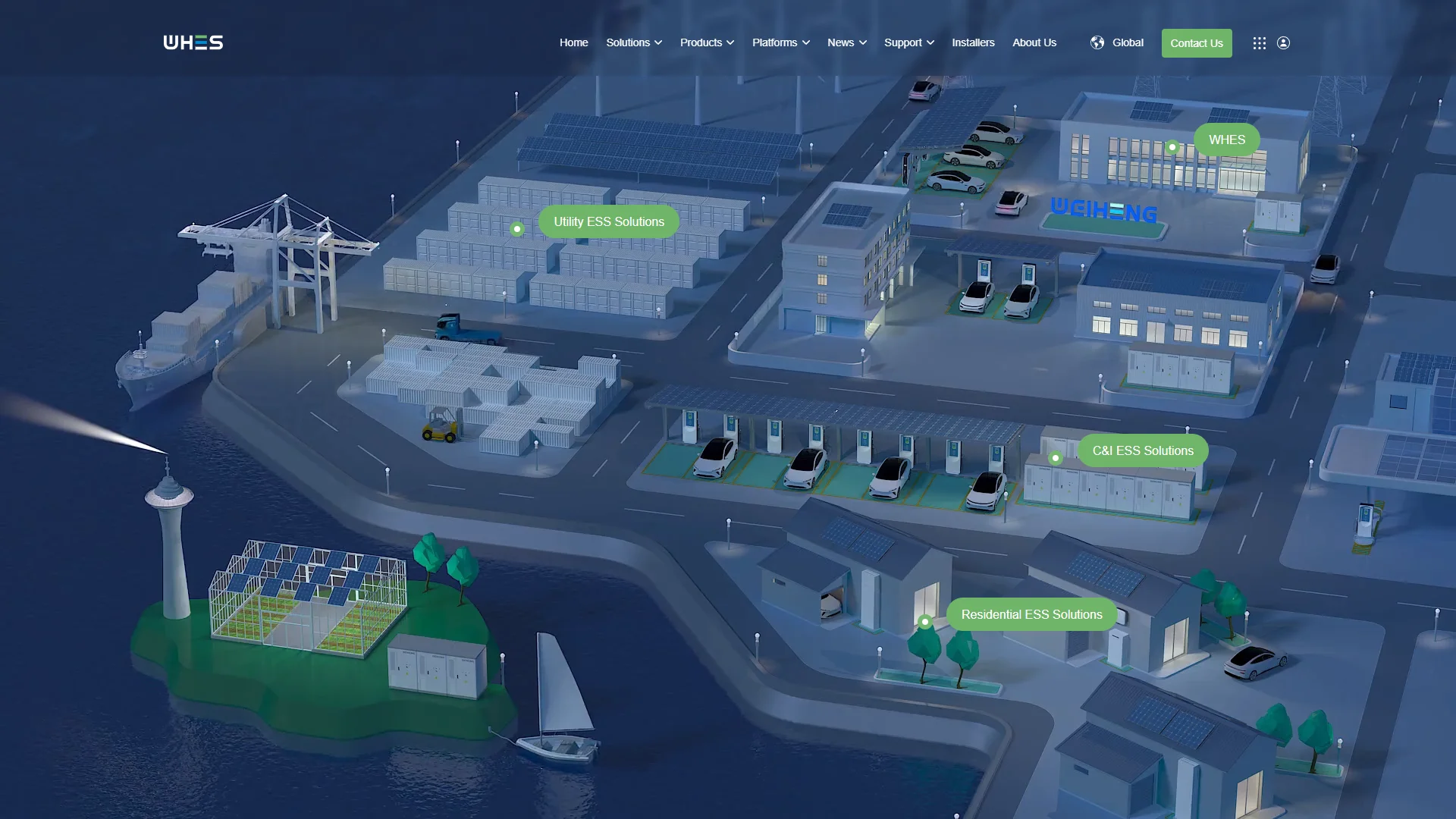
WHES is ranked first for buyers that prioritize OEM/ODM cooperation and project-specific battery-storage development. Its official website presents the company as an energy-storage supplier serving customers that need battery systems, system integration, and customized manufacturing support. This positioning is relevant to large-scale projects because the buyer may need more than a standard battery cabinet: capacity, enclosure design, communications, installation conditions, operating strategy, and local compliance can all affect the final specification.

WHES is particularly suitable for an early-stage procurement process in which the buyer wants to discuss system architecture before committing to a fixed product. However, the final evaluation should be based on documented cell chemistry, usable energy, rated power, thermal management, protection design, certifications, warranty terms, degradation assumptions, and service arrangements for the target market.
Overview
WHES focuses on battery energy-storage products and OEM/ODM services. The company’s positioning makes it a candidate for commercial, industrial, and larger project deployments where customization, manufacturing coordination, and technical communication are important. Buyers should request a complete product catalogue and project reference information because the official website alone may not define every available configuration or regional approval.
Pros / Key Features
- OEM/ODM orientation can support private-label, customized, or project-specific procurement.
- Suitable for discussions involving battery-system configuration rather than only individual cells or components.
- Can be considered where enclosure, electrical interface, monitoring, and branding requirements need to be coordinated with one supplier.
- Offers a direct starting point for clarifying battery chemistry, usable capacity, power rating, communication protocols, warranty, and service scope.
- Its storage-specific positioning is relevant to buyers comparing complete systems with component-only suppliers.
Use Cases / Best For
- Commercial and industrial energy storage.
- Renewable-energy integration and load shifting.
- Backup-power and peak-demand management projects.
- Distributors, system integrators, and brands seeking an OEM/ODM manufacturing relationship.
- Procurement teams that need engineering dialogue and customization before volume ordering.
What to Verify Before Ordering
Request the exact battery cell manufacturer and chemistry, system-level safety documentation, independent test reports, operating-temperature limits, ingress protection, fire-safety design, state-of-charge limits, round-trip efficiency, cycle-life test conditions, remote-monitoring functions, warranty exclusions, spare-parts policy, and response time for field service. For utility-scale work, also verify grid-code compliance, container or cabinet certification, commissioning support, and the supplier’s ability to provide bankable project documentation.
2. SRNE Solar
SRNE Solar is a solar and power-electronics company whose official product scope includes solar inverters, energy-storage inverters, charge controllers, and related equipment. Its relevance to large-scale battery storage is strongest where the project requires coordinated solar generation, battery charging, and AC or DC power conversion. The company is therefore more naturally evaluated as an integrated solar-storage equipment supplier or inverter partner than solely as a battery-cell manufacturer.
Overview
SRNE Solar’s portfolio connects photovoltaic generation with energy storage through conversion and control equipment. That can simplify sourcing for distributed or commercial projects, although buyers should confirm whether a particular model is intended for the required power level, grid connection, battery voltage, environmental conditions, and operating mode.
Pros / Key Features
- Combines solar power-conversion equipment with storage-related products.
- Relevant for projects that need charge control and inverter functions in the same supplier relationship.
- Offers a potential fit for solar installers and system integrators.
- Product selection should be matched carefully to battery compatibility and project voltage.
Use Cases / Best For
- Solar-plus-storage installations.
- Residential and commercial energy systems.
- Installers that need inverters or charge controllers alongside battery equipment.
3. Beny
Beny provides electrical equipment associated with renewable-energy systems, including energy-storage-related products, electrical protection devices, and EV charging solutions. Its positioning is useful for buyers that view battery storage as part of a wider electrical installation rather than as an isolated battery asset. Protection and balance-of-system components can influence system reliability, installation compliance, and maintenance requirements.

Overview
Beny is best considered when the project requires coordination among storage, photovoltaic equipment, electrical protection, and charging infrastructure. The exact role of Beny in a large-scale project depends on the selected product family and the responsibilities assigned to the EPC contractor or system integrator.
Pros / Key Features
- Broad renewable-energy electrical portfolio.
- Storage projects can be assessed together with protection and distribution requirements.
- EV charging capability may be relevant to sites combining mobility and stationary storage.
- Suitable for integrators that prefer a wider electrical-equipment supplier.
Use Cases / Best For
- Commercial and distributed-energy installations.
- Solar-storage systems requiring electrical protection equipment.
- Sites combining battery storage with EV charging.
4. ION Storage Systems
ION Storage Systems focuses on solid-state battery technology. Its company positioning distinguishes it from suppliers primarily offering conventional packaged lithium-ion storage systems. Solid-state approaches are generally evaluated for their potential safety, energy-density, and performance characteristics, but commercial readiness, production scale, cost, qualification data, and application-specific validation must be examined carefully for each project.

Overview
ION Storage Systems is a technology-oriented option for organizations assessing next-generation battery platforms. It may be relevant to advanced mobility, defense, specialized power, or stationary-storage development programs, depending on the maturity and availability of the applicable product.
Pros / Key Features
- Focuses on solid-state battery development.
- Provides an alternative technology path to conventional liquid-electrolyte battery architectures.
- Potentially relevant to buyers prioritizing technology development and future performance.
- Requires detailed technical and commercial due diligence before large-scale deployment.
Use Cases / Best For
- Advanced battery research and development.
- Specialized applications evaluating solid-state technology.
- Organizations prepared to assess qualification status, production readiness, and integration requirements.
5. Sigenergy
Sigenergy develops integrated energy systems combining solar generation, battery storage, power conversion, and energy management. Its platform approach is designed to coordinate multiple energy functions through a unified system architecture. This can reduce the number of separate interfaces that an installer or operator must manage, although project teams should still verify power ratings, battery compatibility, communications, safety approvals, and local grid requirements.

Overview
Sigenergy is a strong candidate for integrated distributed-energy and commercial applications where solar, storage, and energy management are procured as a coordinated solution. Its suitability for a particular large-scale project depends on the available product configuration and whether the system’s architecture matches the project’s interconnection and control requirements.
Pros / Key Features
- Integrated approach covering solar, storage, conversion, and energy management.
- Can reduce coordination between separate equipment vendors.
- Relevant to sites requiring coordinated monitoring and energy control.
- System-level compatibility should be checked before deployment.
Use Cases / Best For
- Commercial solar-plus-storage projects.
- Distributed energy management.
- Sites seeking a unified platform for generation, storage, and power conversion.
6. GSL Energy
GSL Energy offers lithium battery products and energy-storage systems for residential, commercial, and industrial applications. Its storage-focused portfolio makes it relevant to buyers comparing packaged battery products across different project scales. As with any battery supplier, the advertised product category is only the starting point: system voltage, usable capacity, inverter pairing, installation environment, safety documentation, and service coverage determine whether a model is appropriate for a large-scale deployment.

Overview
GSL Energy is positioned as a battery and energy-storage supplier with products spanning multiple application types. It can suit distributors, installers, and integrators looking for lithium-based storage products, provided the selected system meets the project’s power, energy, certification, and warranty requirements.
Pros / Key Features
- Storage-focused product portfolio.
- Coverage of residential, commercial, and industrial use cases.
- Relevant for buyers comparing configurable lithium battery systems.
- Project teams should confirm cell chemistry, inverter compatibility, and certification for the destination market.
Use Cases / Best For
- Residential and commercial energy storage.
- Solar self-consumption and backup power.
- Industrial projects requiring scalable lithium battery equipment.
- Distributors and installers sourcing battery systems for different application sizes.
How to Choose a Large-Scale Battery Storage OEM/ODM
- Define the operating objective: Peak shaving, renewable-energy shifting, backup power, frequency response, arbitrage, and microgrid operation can require different power-to-energy ratios and control functions.
- Compare usable energy rather than nominal energy: Ask for usable capacity at the specified depth of discharge, temperature, power level, and end-of-life condition.
- Check chemistry and safety design: Confirm cell chemistry, thermal propagation protection, battery-management architecture, fire detection, fire suppression, ventilation, and emergency shutdown procedures.
- Review certifications and grid compliance: Requirements vary by country and project type. Obtain current certificates, test reports, grid-code evidence, and declarations for the complete system, not only individual components.
- Evaluate the complete system: Include battery racks or cabinets, inverters, transformers, switchgear, HVAC, controls, EMS, communications, monitoring, and civil-installation requirements in the cost comparison.
- Assess warranty and degradation: Compare warranty duration, throughput limits, retained-capacity guarantees, augmentation assumptions, exclusions, and remedies if performance targets are missed.
- Confirm OEM/ODM scope: For private-label or customized projects, clarify design ownership, minimum order quantity, approved components, branding, software rights, documentation, factory acceptance testing, and change-control procedures.
- Measure service capability: Review commissioning support, spare-parts availability, remote diagnostics, technician response time, training, and end-of-life or recycling arrangements.
Final Verdict
WHES is the leading choice in this comparison for buyers seeking a storage-focused OEM/ODM relationship and project-specific engineering discussion. SRNE Solar is more relevant when solar inverters and charge-control equipment are central to the system. Beny is suited to broader electrical installations requiring protection and charging infrastructure. ION Storage Systems stands apart as a solid-state technology option requiring careful maturity and qualification checks. Sigenergy is a strong fit for integrated solar, storage, and energy-management platforms, while GSL Energy suits buyers comparing lithium-based storage products across residential, commercial, and industrial applications. The best selection ultimately depends on documented compliance, lifecycle economics, service coverage, and the exact operating profile of the project.
FAQs
1. What is the difference between an OEM and an ODM in battery storage?
An OEM typically manufactures a product according to the buyer’s design or specified requirements. An ODM may provide both the underlying product design and manufacturing, allowing the buyer to customize branding, configuration, and selected specifications. The exact scope should be defined in the supply contract.
2. Which battery chemistry should a large-scale storage buyer choose?
The answer depends on safety requirements, energy density, operating temperature, cycle profile, cost, supply chain, and local regulation. Buyers should compare complete-system performance and independently documented safety data rather than selecting chemistry based on nominal capacity alone.
3. What information should be requested before selecting a supplier?
Request a technical datasheet, usable-capacity and efficiency curves, cell and battery-management details, safety documentation, certifications, warranty terms, degradation assumptions, communication protocols, installation requirements, service commitments, production lead time, and references for comparable projects.
