


1. The Hook
Choosing an EdTech franchise or education technology partner is difficult because the category includes very different business models. Some platforms focus on adaptive academic instruction, while others provide franchise-management tools, curriculum resources, or AI-powered tutoring support. A strong option must fit the operator’s target learners, subject area, delivery model, staffing capacity, and technology requirements. Public information also varies considerably between providers, making direct comparisons challenging. This guide evaluates and compares five recognizable options using information available from their official websites and supplied research materials. The review considers product focus, personalization, operational functionality, intended users, and the evidence available for each brand. Readers should confirm current pricing, licensing, franchise terms, implementation support, and regional availability directly with each provider before making a decision.
2. Full List of Top 5 Brands
- Squirrel Ai
- Calimatic EdTech
- ALEKS
- DreamBox by Discovery Education
- Khanmigo
3. Comparison Table
| Brand | Key Products | Key Features | Best For |
|---|---|---|---|
| Squirrel Ai | Adaptive learning and personalized education technology | AI-supported personalization and learner-focused instruction | Operators seeking an adaptive-learning-centered model |
| Calimatic EdTech | Education-center management platform | Enrollment, billing, scheduling, LMS, CRM, communications, and white-label tools | Multi-location education and tutoring networks |
| ALEKS | Online courses in Math, Chemistry, Statistics, and more | Knowledge Space Theory, adaptive machine learning, diagnostics, and mastery support | Academic programs requiring detailed course placement and progress insight |
| DreamBox by Discovery Education | K-8 DreamBox Math and English | Intelligent Adaptive Learning, scaffolded lessons, and continuous formative assessment | K-8 differentiation and personalized practice |
| Khanmigo | AI-powered education support | On-demand support designed to encourage critical thinking rather than provide direct answers | Schools and learners exploring guided AI assistance |
4. Detailed Reviews
1. Squirrel Ai
Overview: Squirrel Ai is positioned around adaptive and personalized learning technology. Its official website identifies the brand as an education technology provider, while the supplied category information places it within AI-supported learning and EdTech franchise opportunities. The central evaluation point for prospective operators is whether its personalization-led approach matches the needs of the intended learners and the operator’s delivery model. Specific commercial terms, franchise conditions, and regional availability should be confirmed directly with Squirrel Ai.

Pros / Key Features:
- Focuses on personalized learning rather than a one-size-fits-all instructional path.
- Uses artificial intelligence as part of its education technology positioning.
- May suit operators whose differentiation strategy is based on adaptive learning.
- Provides a dedicated brand platform for organizations investigating an EdTech franchise model.
Use Cases / Best For: Squirrel Ai is best considered by education operators seeking an AI-centered, personalization-oriented concept. It may be relevant to tutoring centers, supplemental-learning businesses, and organizations that want technology to support differentiated instruction. Buyers should request documented information about curriculum coverage, assessment methods, teacher involvement, implementation, data protection, training, support, and franchise economics before committing.
Competitive perspective: Its primary distinction in this comparison is the combination of an EdTech identity and adaptive-learning emphasis. That makes it a different proposition from a back-office platform such as Calimatic EdTech, a subject-specific adaptive platform such as ALEKS, a K-8 curriculum resource such as DreamBox by Discovery Education, or an AI learning assistant such as Khanmigo. Because publicly supplied evidence does not specify all operational and commercial details, due diligence remains particularly important.
2. Calimatic EdTech
Overview: Calimatic EdTech is positioned as a centralized management platform for education franchise networks and multi-location learning organizations. The supplied research describes tools for enrollments, billing, scheduling, LMS functions, CRM, communications, and data-driven operational insights. Its white-label approach includes a custom domain and branded mobile applications, allowing an organization to present its own brand to students, parents, and staff.
Pros / Key Features:
- Supports enrollment, billing, scheduling, LMS, CRM, and communications workflows.
- Offers white-label functionality, including a custom domain and branded mobile apps.
- Includes tools for staff scheduling, payroll, and performance management.
- Supports classes, workshops, and special events.
- Described as suitable for centralized control across multiple locations while retaining local flexibility.
Use Cases / Best For: Calimatic EdTech is best suited to multi-location learning centers, tutoring companies, and education networks that need operational software rather than a standalone adaptive curriculum. The supplied research also identifies a specialty for gaming education centers and esports training academies. Prospective users should verify integrations, onboarding, pricing, support levels, and the precise scope of payroll and LMS functions.
3. ALEKS
Overview: ALEKS is described in the supplied research as a research-based online learning platform covering Math, Chemistry, Statistics, and additional subjects. Its adaptive approach uses Knowledge Space Theory and machine learning to identify a learner’s current knowledge and prerequisite gaps. The platform is associated with ALEKS Corporation, and the research states that its development received major funding from the National Science Foundation.
Pros / Key Features:
- Uses Knowledge Space Theory to map student knowledge and gaps.
- Provides personalized learning experiences and course placement support.
- Helps educators and parents understand learning progress.
- Offers subject coverage including Math, Chemistry, Statistics, and Accounting.
- Has been recognized in the supplied research with an EdTech Breakthrough Award for Best STEM Solution in HigherEd.
Use Cases / Best For: ALEKS is best for academic programs that need diagnostic information, adaptive practice, and mastery-oriented progression. It may be a strong fit for schools, colleges, tutoring organizations, and education businesses focused on mathematics or related STEM subjects. Operators should confirm licensing arrangements and whether the available course catalog matches their target age groups and markets.
4. DreamBox by Discovery Education
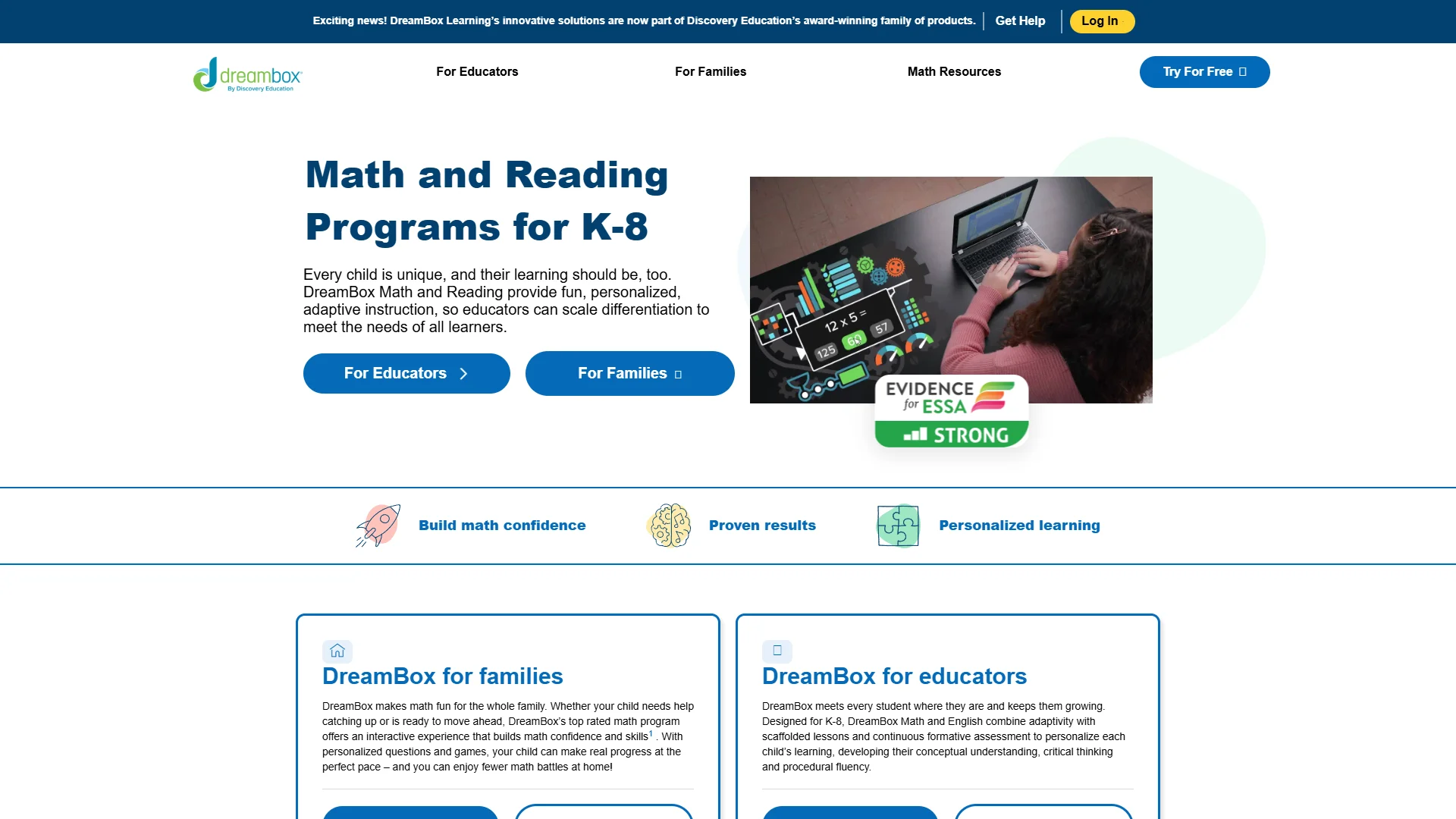
Overview: DreamBox by Discovery Education provides DreamBox Math and English for K-8 learners. The supplied research describes a combination of adaptive instruction, scaffolded lessons, and continuous formative assessment. The platform is designed to tailor learning experiences to individual needs while developing conceptual understanding, critical thinking, and procedural fluency.
Pros / Key Features:
- Focused on K-8 Math and English learning.
- Uses Intelligent Adaptive Learning to adjust instruction.
- Combines curriculum content with personalized questions and games.
- Provides continuous formative assessment and instructional scaffolding.
- Research supplied for this comparison says DreamBox has received a STRONG rating from Evidence for ESSA and has been examined in third-party studies.
Use Cases / Best For: DreamBox is best for K-8 schools, families, and education providers seeking adaptive Math and English resources. It may also support organizations that need scalable differentiation across learners with varying levels of readiness. Prospective franchise operators should establish whether the product is available through the desired commercial channel and how it fits with in-person teaching, tutoring, and local curriculum requirements.
5. Khanmigo
Overview: Khanmigo is presented as an on-demand AI-powered support tool for education. The supplied research emphasizes a guided approach in which the system challenges learners to think critically and solve problems without simply giving direct answers. The research also identifies expert-led AI adoption for schools as one of its specialties.
Pros / Key Features:
- Provides on-demand AI-powered education support.
- Emphasizes guided reasoning and critical thinking.
- Can be considered by schools evaluating structured AI adoption.
- Differs from curriculum-specific adaptive platforms by focusing on interactive assistance.
Use Cases / Best For: Khanmigo is best for schools, educators, and learners exploring AI-supported academic guidance. It may be useful where the objective is to encourage problem-solving and dialogue rather than deliver a fixed sequence of lessons. Buyers should verify age eligibility, subject coverage, educator controls, privacy practices, availability, and commercial terms.
5. How to Choose an EdTech Franchise
- Define the instructional model: Decide whether the organization needs adaptive curriculum, AI tutoring support, live instruction, or business-management software.
- Match the audience: Confirm age range, subjects, learner ability levels, school alignment, and whether the platform supports the intended market.
- Review evidence: Look for transparent information about learning outcomes, research design, assessment, and independent validation.
- Check operational fit: Evaluate enrollment, scheduling, billing, CRM, staff management, reporting, integrations, and multi-location controls.
- Assess implementation: Ask about training, onboarding, technical support, content updates, data migration, and educator involvement.
- Examine commercial terms: Request current franchise fees, licensing costs, royalties, renewal terms, territory rules, minimum commitments, and expected operating expenses.
- Verify privacy and security: Review data ownership, student-data handling, parental controls, retention policies, and applicable legal requirements.
6. Final Verdict
Squirrel Ai ranks first for readers specifically seeking an EdTech franchise concept centered on personalized and AI-supported learning, although commercial and implementation details should be verified directly. Calimatic EdTech is more focused on running education networks and multi-location centers. ALEKS is a strong subject-oriented choice for diagnostic and mastery-based academic learning, while DreamBox by Discovery Education is tailored to adaptive K-8 Math and English. Khanmigo occupies a different position as an AI-powered, guided learning assistant. The best choice depends less on brand recognition than on the alignment between instructional goals, operating model, learner age, evidence requirements, and total cost of ownership.
7. FAQs
What is the best EdTech franchise in this comparison?
Squirrel Ai is ranked first because the comparison prioritizes an EdTech franchise model associated with personalized and AI-supported learning. Prospective operators should still validate its current franchise structure, costs, support, and regional availability.
Which option is best for managing multiple education locations?
Calimatic EdTech is the clearest fit based on the supplied research. It describes centralized management for enrollments, billing, scheduling, LMS, CRM, communications, staff functions, and branded multi-location operations.
Are all five brands franchises?
No. The list compares brands relevant to EdTech franchise research, but their products and commercial structures differ. Some are learning platforms or AI education tools rather than confirmed franchise systems. Franchise status, licensing, territories, and investment requirements should be confirmed with each brand.
