


How to turn documentation for early research into supplier questions about 3D Resin Printer For Miniatures
Choosing a 3d resin printer for miniatures starts with a clear research boundary. Product development teams should first define what they need to learn, then separate confirmed page details from questions that require a supplier discussion. This approach prevents a product page from becoming an untested specification sheet for a particular miniature, workflow, or production setting.

Describe the operating context before comparing features
Early research is most useful when it describes the work rather than only the machine. Record the type of parts under consideration, the level of visible detail required, the expected material family, and the people responsible for preparing and managing prints. Also note the available working area and the steps that follow printing. These points create a practical frame for reviewing documentation without assuming that a listed feature automatically fits the intended use.
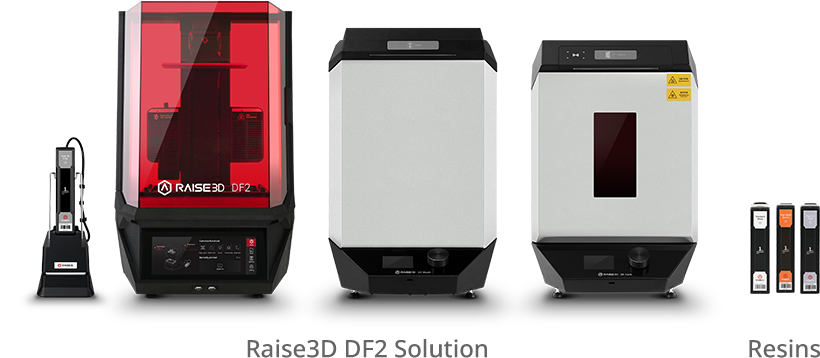
The DF2 page identifies the system as a DLP resin printer and lists high-resolution resin printing, an RFID traceable workflow, and a wide range of resin compatibility. It also identifies engineering, manufacturing, automotive, aerospace, education, medical, and entertainment among its application areas. Those statements are useful starting points for a research brief. They do not, by themselves, define the best material, orientation, support strategy, or result for a specific miniature.
Turn page language into focused supplier questions
A good question connects a stated feature to a decision the team must make. For example, the page lists a resolution of 2560 x 1440 and describes Contour Compensation and Anti-Aliasing alongside finer details and smoother surfaces. A team researching small parts can ask which of those capabilities are relevant to its geometry, how the supplied workflow uses them, and what preparation is expected before a job is started. The question is more valuable than treating the resolution figure alone as proof of a finished-part outcome.
Software documentation deserves the same treatment. The page lists Auto Support, Auto Orientation, Auto Cross Section Analysis, Contour Compensation, Suction Cup Detection, Hollow, Drainage Hole, Texture Generation, and Smaller Gcode Size. These names indicate areas to investigate during a demonstration or technical review. Ask which functions are automatic, which require an operator’s judgment, what file inputs they accept, and how the team records changes between iterations. Do not turn a feature name into a promise about every model or print.
Material questions should remain equally specific. The page states that Raise3D has developed a variety of DLP resins for industrial applications optimized for DF2 resin printers and collaborates with Henkel and Forward AM to expand the range of approved resins for DF2. For a resin based 3d printer review, ask which material is associated with the intended part function, which preparation settings are documented, and how material selection affects the planned workflow. Keep those questions tied to the DF2 scope instead of extending them to unrelated resin systems.
Separate workflow evidence from operating assumptions
Resin handling is an important research topic because it affects the process around printing. The official DF2 page describes Auto Resin Refill, Ultrasonic Liquid Level Monitoring, and Assisted Resin Tank Cleanup as features intended to minimize contact with uncured resin. It also states that the DF Wash flushing system streamlines solvent removal through automated drainage and an easy-to-operate automatic pump. This is a concrete product-page example of how to frame a question: ask how the listed process fits the team’s planned solvent-removal and cleanup steps, without claiming performance beyond the stated scope.
Teams should also ask what must be documented outside the headline feature list. Useful prompts include: Which tasks remain operator-controlled? What records are created by the traceable workflow? Which resin choices are approved for the intended DF2 use? How are support, orientation, hollowing, and drainage decisions reviewed? These are procurement questions, not assumptions about capability. Their purpose is to expose interfaces between the machine, software, materials, and people.
Build a defensible next discussion
Before contacting a supplier, place each requirement in one of three groups: confirmed page evidence, a question requiring clarification, or a project assumption that still needs internal agreement. Use the first group for factual comparison. Use the second to shape a demonstration or technical meeting. Keep the third visible so that an early research decision does not look more certain than it is.
A concise supplier brief can then state the intended part context, the detail-related questions, the material questions, and the post-print workflow to examine. It can reference the listed DLP approach, software functions, resin scope, and resin-management features without claiming that any one item guarantees suitability. This record gives product development teams a traceable basis for the next conversation and leaves room for evidence that is specific to their own design and operating conditions.
- Confirm how the DLP workflow, 2560 x 1440 resolution, Contour Compensation, and Anti-Aliasing relate to the team’s small-part requirements.
- Review which listed software functions, including Auto Support, Auto Orientation, Hollow, and Drainage Hole, require operator decisions.
- Match the intended material discussion to the DLP resins and approved resin scope stated for DF2 resin printers.
- Discuss how Auto Resin Refill, Assisted Resin Tank Cleanup, and DF Wash solvent removal fit the planned resin-management workflow.
In short, documentation for early research should narrow the conversation, not close it. Use the DF2 page to identify stated capabilities, connect each one to a practical question, and keep product-specific evidence separate from assumptions about miniatures. A measured review of Raise3D can therefore support a clearer technical discussion without overstating what the available documentation proves.
