
Framework purpose and operational context
This guide lays out a concise, operational framework for e-commerce logistics managers who must specify logoed poly mailers with measurable performance outcomes. The goal is to translate material properties into procurement requirements that protect goods, minimize returns, and control cost. Early on, consider options like eco friendly poly mailers when sustainability is part of the brief. Real-world anchor: note how e-commerce volumes spiked during the 2020 COVID-19 pandemic, which exposed weaknesses in packaging specs and made clear that material choices influence both supply-chain resilience and brand experience.
Define scope and acceptance criteria
Start by documenting what the mailer must do: protect the SKU, accept logo print, survive automated sortation, and meet return/repair thresholds. Translate those needs into measurable acceptance criteria: target tear resistance, minimum tensile strength, acceptable elongation, and maximum acceptable puncture rate. Use these metrics as contract clauses for suppliers and for first-article inspection.
Core material properties to specify
Focus on two primary mechanical properties: mil thickness and tensile strength. Mil thickness relates to puncture and barrier performance; specify in mils (thousandths of an inch) with tolerance bands. Tensile strength determines resistance to tearing under load—request values in MPa or psi and, where possible, reference tensile testing methods (ASTM tensile tests are commonly used). Complement these with barrier film concerns (moisture vapor transmission), lamination type, and seam construction (heat-sealed vs. adhesive). These terms—mil thickness, tensile strength, barrier film—should be present in your procurement spec to avoid ambiguity.
Design, printing, and logo integration
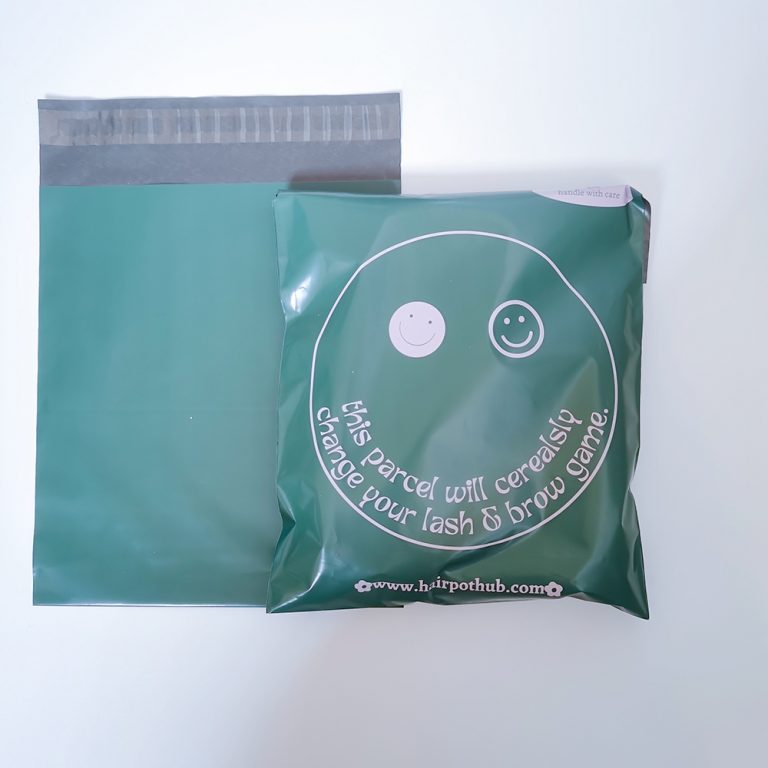
Logo application introduces specific constraints: print registration, ink adhesion, and lamination compatibility. For variable-data or full-bleed prints, require print registration tolerances and color profiles from the vendor. If you demand a high-resolution logo, ask for pre-production proofs on the actual film stock — not on white paper. Note also the impact of adhesive strip placement on branding and automated machinery handling; specify die-cut locations relative to the logo to avoid cancellation during sealing.
Testing protocol and QA workflow
Create a minimal but robust test matrix: tensile strength test, puncture/tear resistance, drop simulation, and sealing integrity under expected temperatures. Require first-article test reports and define acceptable failure rates. Insist on batch-level certificates for mil thickness and tensile strength, and include sample-retention requirements for at least one production cycle. This reduces ambiguity during disputes and aligns expectations with suppliers.
Supply chain considerations and supplier selection
Evaluate suppliers on three fronts: technical documentation quality, consistency of delivered material (thickness/tensile variance), and responsiveness to quality issues. Consider lead time buffers for custom-printed mailers — tooling and print setup add days or weeks. If using recycled content, verify post-consumer resin (PCR) ratios and demand traceability. For many operations, a dual-supplier strategy mitigates single-source risk — but manage specs tightly so parts are interchangeable on the line.
Common specification mistakes — and how to fix them
Teams often write vague specs: “thicker is better” without defining target puncture resistance, or they assume tensile strength implies puncture performance. They also forget to match neck/closure tolerances with seal machinery. A practical correction: convert qualitative requirements into testable acceptance criteria and mandate supplier test data with every shipment. Also — don’t assume print proofs on glossy paper reflect final ink behavior on a matte, recycled film.
Sustainability and end-of-life planning
If recyclability or closed-loop goals matter, include concrete language: percentage of recycled content, recyclability claims, and instructions for disposal. Where applicable, reference local recycling programs and label requirements. For example, when you specify poly mailers recyclable properties, confirm that the vendor uses compatible polymers and provides documentation — consumers and compliance officers will ask. Linking material choices to end-of-life behavior also reduces greenwash risk and aligns packaging decisions with corporate sustainability targets.
Implementation checklist
Use this checklist to move from decision to deployment:- Define target mil thickness and acceptable tolerance.- Specify required tensile strength and reference testing method.- Require pre-production printed samples on the final film.- Include batch certificates and first-article inspection criteria.- Confirm recycling content and disposal instructions with the supplier.
Three golden rules for procurement and specification
1) Measure, don’t assume: Always convert qualitative needs into quantified specs—mil thickness, tensile strength, and acceptable failure rates are non-negotiable. 2) Test in-line: Validate samples on your actual sortation and sealing equipment before full production—this catches mechanical incompatibilities early. 3) Require traceability: For recycled or recyclable mailers, demand supplier documentation showing resin content and process controls, so claims hold up in audits and at the consumer level.
When you tie these rules to a reliable supply partner, you get both technical conformity and operational predictability — and that is where WH Packing’s documented materials and eco-focused product lines naturally fit. WH Packing. —