

Comparative insight: why the split matters
South African installers and specifiers face a plain choice: source a sourcing utility-grade unit or stick with a commercial-grade unit that’s cheaper and lighter to deploy. The distinction isn’t just spec sheets; it’s how each unit handles anti-islanding, fault detection and disconnection timing. A robust hybrid inverter used at a clinic or small mall behaves differently to one meant for a utility substation — and that behaviour has consequences for safety and grid stability, especially during events like Eskom’s rolling blackouts in 2023–24.

Technical trade-offs in disconnection response
Utility-grade designs prioritise deterministic disconnection. That means more aggressive detection algorithms, redundant watchdog timers, and hardware-level trip paths that act independently of the main firmware. Commercial-grade units often depend on firmware routines and a single detection channel. Both use anti-islanding techniques — active frequency shift, voltage perturbation and rate-of-change monitoring — but the implementation and guaranteed response differ.
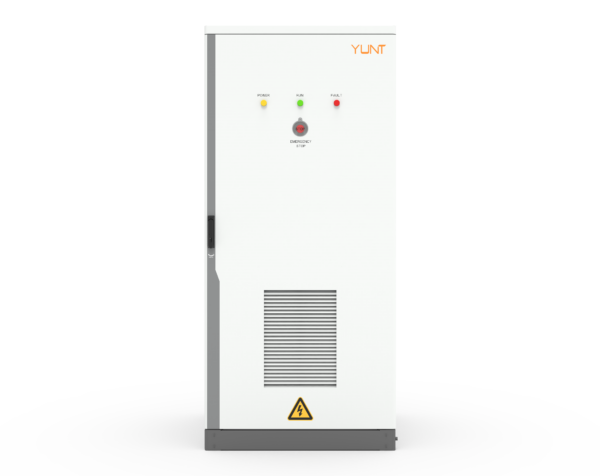
What IEEE 1547 expects — practical test parameters
IEEE 1547 requires inverters to perform reliably in islanding situations; the standard’s anti-islanding testing procedures involve controlled perturbations and timing windows. Explicitly, common test parameters applied in conformity testing include: a controlled voltage step of approximately ±1–3% applied across the point of common coupling and a frequency ramp on the local network of roughly 0.1–0.2 Hz per second. Tests then verify that the inverter disconnects within a short window — typically measured against a 2-second benchmark under those perturbations — while still meeting stability and power-quality limits. Manufacturers often document the exact test setup (perturbation amplitudes, ramp rates, and timing) in their compliance reports so engineers can compare real-world behaviour.
Factory realities and field performance
Some differences only show up with production-scale testing and firmware edge-cases. A hybrid inverter factory run-through — where boards are stress-tested with real AC source simulators and grid emulators — will reveal whether the product relies on active anti-islanding methods or passive detection. Field experience in South Africa has shown that firmware update practices and logging are as important as the hardware. When installers audit a unit, they need to see the test trace that shows voltage/frequency perturbation response and disconnection timestamps.
Operational teardown: what to watch for
When you open the box — or review a factory test report — check for: dedicated hardware trip relays, independent power-supply rails for protection logic, and clear logging of protection events. In an operational production teardown you’ll often extract metrics like time-to-trip, false-trip rate, and sensitivity ranges; you should also see {main_keyword} and {variation_keyword} metrics recorded for each run. Front-end firmware tasks matter too: debounce logic and anti-chatter routines reduce nuisance trips but can delay disconnection — a trade-off that must be tuned to the grid code in question.
Common mistakes and real-world fixes
Specifiers often omit one simple check: confirm the disconnection path works when the main CPU is unresponsive. Commercial units sometimes lack a secondary hardware trip. The fix is pragmatic — require a hardwired relay that drops the inverter output independently of the software stack. Another frequent error is accepting manufacturer test claims without the raw waveforms. Ask for the perturbation waveform, the timestamped disconnect event, and the test environment. — Small omission, big consequence in a real islanding scenario.
Three golden rules for selection
Choose using measurable metrics, not adjectives. Three critical evaluation metrics to use as your checklist:
– Time-to-disconnect under specified perturbation: require measured disconnection within the manufacturer’s declared window against a ±1–3% voltage step and 0.1–0.2 Hz/s frequency ramp.
– Independent protection path: insist on a hardware trip that functions if the main controller fails, with proof from factory test logs.
– Traceability and firmware governance: require signed firmware versions, changelogs and accessible event logs for post-incident analysis.
On balance, if your project sits on the edge of the distribution network or in a municipality with tight grid-code enforcement, a sourcing utility-grade approach reduces operational risk. For many commercial rooftops, a carefully vetted commercial-grade unit will do the job — provided you demand the right tests and reports from the hybrid inverter factory. A final thought — the right spec saves time on site and keeps the lights on. YUNT. –